
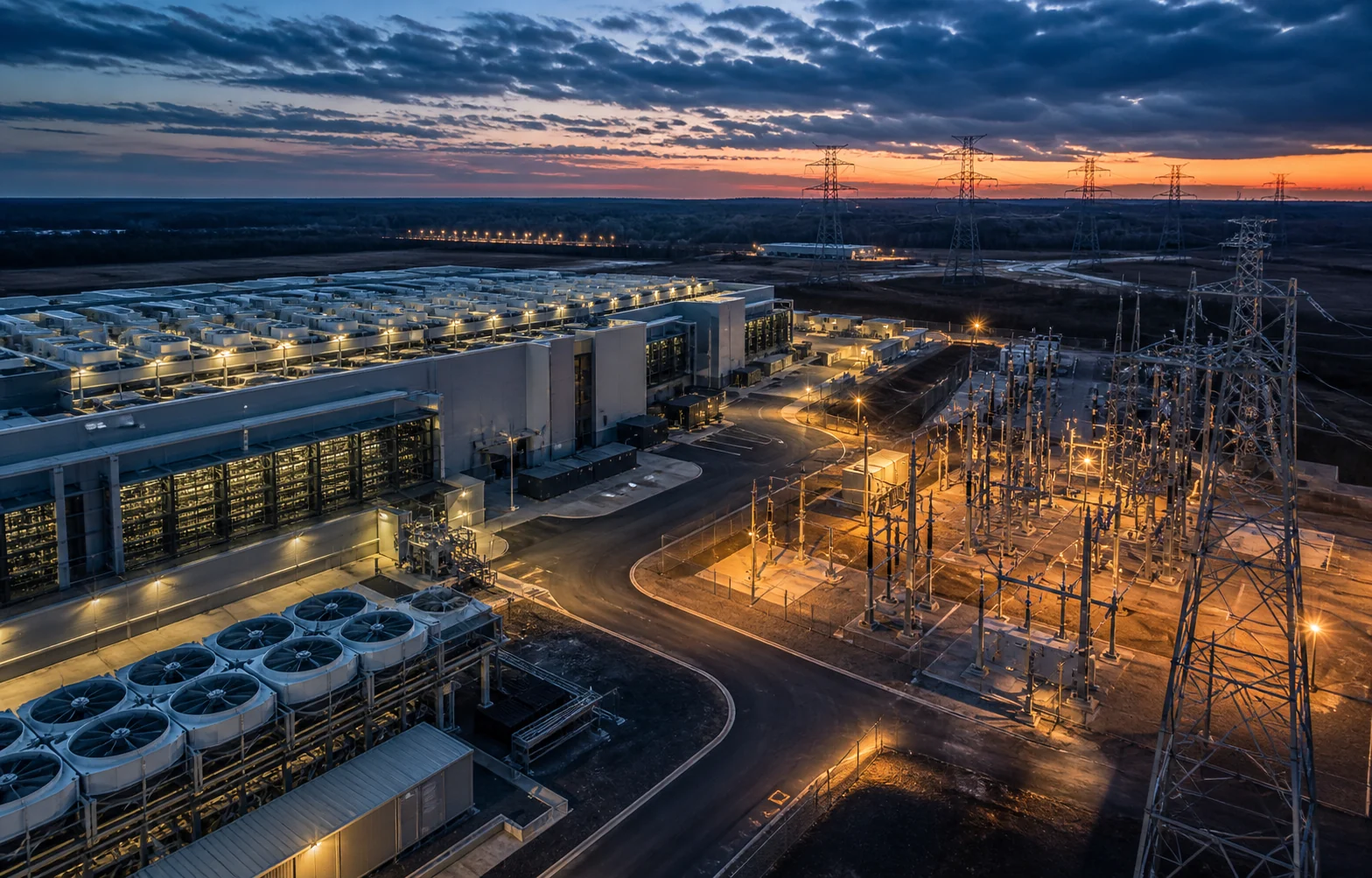
AI feels weightless at the interface. Its infrastructure is anything but. Every training run and inference request depends on power plants, transmission lines, substations, cooling systems, and increasingly sophisticated grid coordination.
As compute clusters grow, electricity is moving from an operating input to a strategic constraint.
Compute growth meets physical limits
Data centers can be designed quickly; grid interconnections cannot. Equipment lead times, permitting, and local capacity increasingly determine where compute can be deployed.
The next frontier of AI may be limited less by chips than by how fast reliable power can reach them.
This creates demand for solutions that add capacity, use existing assets more intelligently, and align flexible compute with grid conditions.
Opportunity across the energy stack
Generation
Firm, low-carbon power and faster project deployment become increasingly valuable.
Grid equipment
Transformers, switchgear, conductors, and power electronics are critical bottlenecks.
Cooling
Higher rack density requires new thermal architectures and water-aware design.
Storage and flexibility
Flexible loads and storage can turn volatility into a system advantage.
Software makes physical assets more productive
Grid software, forecasting, workload orchestration, and real-time energy management can unlock capacity that construction alone cannot deliver fast enough. The winning products will connect operational decisions to measurable reliability and cost.
What durable infrastructure companies share
- 01A product tied to a real physical bottleneck.
- 02Economics that improve for both energy and compute customers.
- 03Deployment capability across regulation, hardware, and software.
- 04Reliability proven under demanding operating conditions.
Intelligence needs an energy strategy.
The companies that connect compute ambition with physical reality will become essential infrastructure for the next technological era.